Brown Sage
Salvia africana-lutea
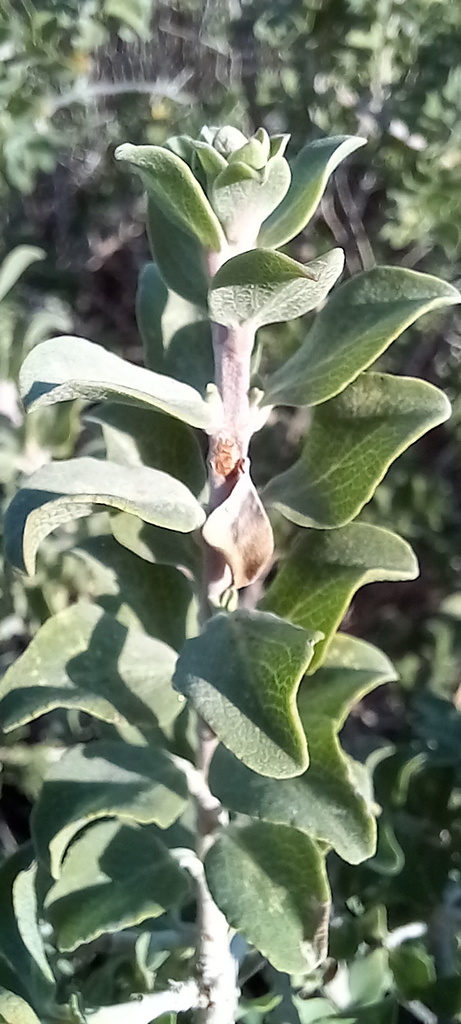 © (c) Anthony Walton, some rights reserved (CC BY-NC), uploaded by Anthony Walton (CC-BY-NC)
Description - from Wikipedia
Salvia aurea (beach salvia, dune salvia, golden salvia, bruin- of sandsalie, geelblomsalie) is a shrubby evergreen perennial native to South Africa.
Description
It has numerous woody stems growing to more than 1 m (3.3 ft)in height and width, with sparse grey-green leaves. The flowers start out as a bright yellow, turning into a rusty color, with the dark rusty-colored calyx persisting long after fruiting begins. The flowers are shaped like a parrot's beak and occur in pairs at the ends of branches.
Taxonomy
The species was first named by Carl Linnaeus in 1753 using the specific epithet afr.lutea, which may be expanded to africana lutea (or africana-lutea). Epithets consisting of two adjectives are not allowed by the International Code of Nomenclature for algae, fungi, and plants, so this name is invalid. Linnaeus's 1762 name Salvia aurea was the accepted name as of April 2024. The lutea part of Linnaeus's 1753 name, meaning yellow, was based on the belief that there were no brown flowers.
Distribution and habitat
This species is native to coastal sand dunes and hills on the coast of the Western Cape, Eastern Cape and Northern Cape in South Africa.
Traditional use
Salvia aurea was used by early European settlers to treat colds, tuberculosis, and chronic bronchitis. Traditional indigenous healers use it for respiratory ailments, influenza, gynaecological complaints, fever, headaches and digestive disorders.
Notes
External links
"Salvia aurea" at South African National Biodiversity Institute