 JonRichfield (https://commons.wikimedia.org/wiki/Category:Eriocephalus_africanus#/media/File:Eriocephalus_africanus_IMG_5718s.JPG)
Cape Snow Bush
Eriocephalus africanus
Animal-friendly
Tolerances & suitability
Growth features
Plant types
Succession
Flowering
- white
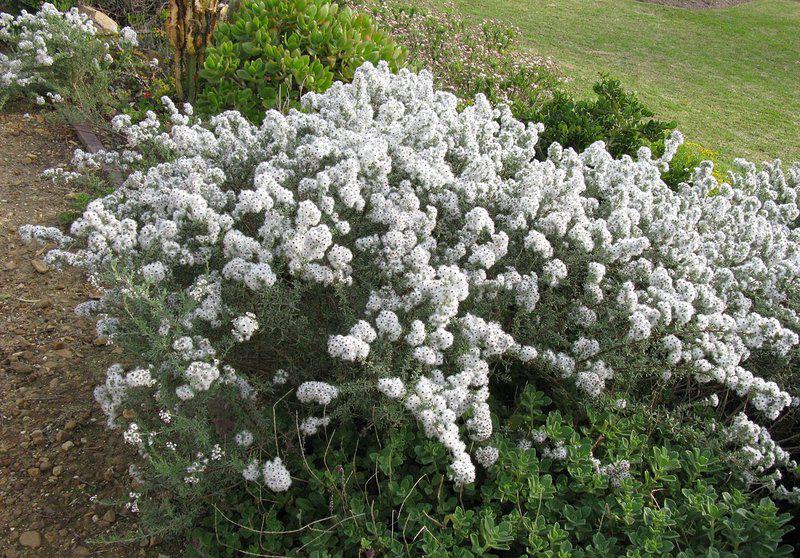
Eriocephalus africanus is a bushy shrublet indigenous to South Africa. It is fragrant, with lightly felted foliage that gives the plant a matt silvery appearance. The inflorescences are small brown and pale yellow heads borne in corymbs; each head bears a few bisexual disk florets with abortive ovaries and snowy white petals that practically cover a bush in flower. The disk florets surround usually some four to eight female florets in the centre.
Its extensive root system makes Eriocephalus africanus resistant to drought and able to recover from grazing by animals.
Ecologically the plant is important to many insects as a source of nectar and pollen, and as a minor browse to flocks and antelope. Essential oil derived from E. africanus is used as an ingredient in medicinal and perfume products. The plant has been used in traditional medicine and in cooking.
Also known as Cape Snow Bush, Wilde Roosmaryn
Propagation by seed
Eriocephalus prefers full sun and well drained soils.In the western Cape it is best to plant during the wet winter months so that the plants can establish themselves before the dry summer.
New plants are easy to propagate from seed or cuttings.
The seed may be sown in autumn or spring and germinates within 10 days.
Propagation by cutting
Eriocephalus roots easily from tip or heel cuttings taken in spring or autumn.The root system is well developed with a taproot that can penetrate the soil to a depth of 6 m, and lateral roots that extend about 2 m around the plant and are closer to the surface.
The shrubs can be pruned lightly to encourage bushy growth, to shape into a hedge or even a ball.