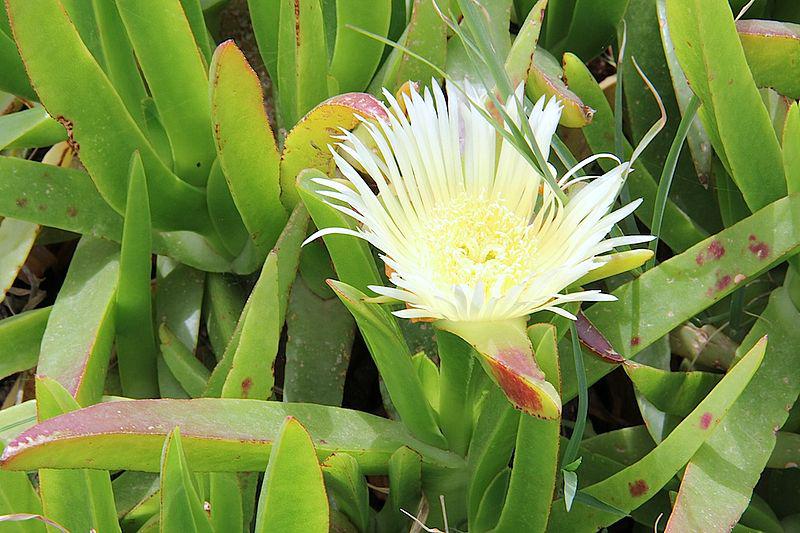
Sea Fig
Carpobrotus edulis
Growth features
Aspect
Plant types
Succession
Soils
Flowering
- yellow
Carpobrotus edulis is a creeping, mat-forming succulent species and member of the stone plant family Aizoaceae, one of about 30 species in the genus Carpobrotus.
The sour fig grows on coastal and inland slopes from Namaqualand in the Northern Cape through the Western Cape to the Eastern Cape. It is often seen as a pioneer in disturbed sites.
Leaves are eaten by tortoises. Flowers are pollinated by solitary bees, honey bees, carpenter bees, and many beetle species. Flowers are eaten by antelopes and baboons. The clumps provide shelter for snails, lizards, and skinks. Fruits are eaten by baboons, rodents, porcupines, antelopes, and people, who also disperse the seeds.
The leaves and fruit have many uses including medicinal. See: http://pza.sanbi.org/carpobrotus-edulis
Other names: 'khoi'-vy, Klipbokvy, Perdevy, Rankvy, Rankvye, Strandvy, Suurvy, Vyerank, Vyeranke, Wilde Vijg