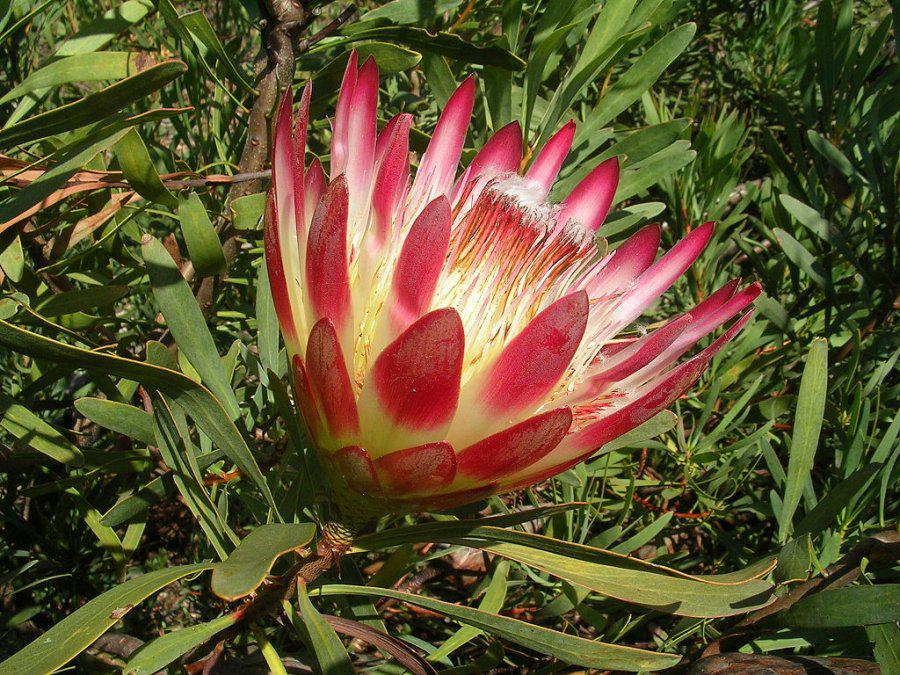
 Thijs nl [GFDL (http://www.gnu.org/copyleft/fdl.html) or CC-BY-SA-3.0 (http://creativecommons.org/licenses/by-sa/3.0/)] (https://upload.wikimedia.org/wikipedia/commons/e/e7/Koningsprotea.jpg)
Common Sugarbush
Protea repens
Animal-friendly
Supports birds
Supports birds
Supports sunbirds
Supports sunbirds
Supports bees
Supports bees
Tolerances & suitability
Drought-resistant
Drought-resistant
Aspect
Sun
Sun
Plant types
Shrub
Shrub
Flowering
- cream
- pink
- red
- white
This is strong bush-shaped shrub with long narrow hairless leaves. It reaches up to 4 meters in height with flowers ranging from red to cream.
It is pollinated by nectar-feeding birds but is visited by many insects as well.
It occurs in both sandstone and clay soils.
The nectar was boiled into a medicinal syrup called 'bossiestroop' in 19th century Cape.
See below for details of germinating from seed.
http://www.proteaatlas.org.za/growseed.htm
http://finebushpeople.com/protea/protea-growing-instructions
http://www.finebushpeople.com/protea/growing-protea-seeds-in-an-eggbox
http://www.proteaatlas.org.za/growgar.htm
Propagation by seed
The slender nut-like seeds have to be treated during storage with a systemic fungicide with the active ingredient of metalaxyl (Apron) and sown from the middle of March, when the day temperature starts to drop. The seed is sown in open seedbeds, in a light, well drained soil and covered with a layer of sand (about 1 cm or 1 1/2 times the size of the seed). The bed is then covered with a grid to protect it against attacks from birds and rodents. The seed will germinate three to four weeks after sowing.Propagation by cutting
Protea repens can be propagated from seed or from cuttings. Good colour forms, hybrids and cultivars have to be propagated from cuttings. Cuttings are made from semi-hardwood, 6-10 cm long, of the current season's growth. The cuttings are dipped for about four seconds in a rooting hormone solution and placed in a growing house with bottom heat (25ºC) and intermittent mist. The rooted cuttings are potted up when the roots are well developed and planted out in the late autumn in South Africa, or in spring in colder areas.Most losses occur during the summer months when a virulent root fungus (Phytophthora camphora) can attack the plants. Control through the use of fungicides in the garden is difficult and expensive. By the time the plant shows distress, it is normally too late to arrest the problem. The best methods of control are cultural, i.e. water plants early in the morning; keep soil surface cool by mulching; remove diseased plants immediately; do not overwater in summer and prune and remove diseased material.