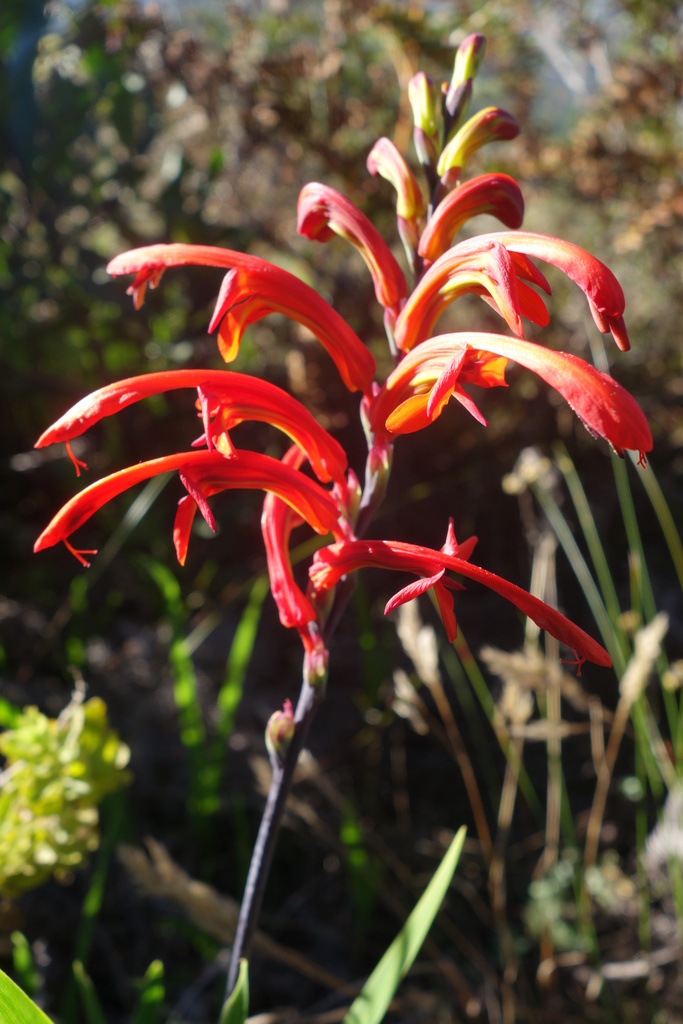
 (c) Tammy, some rights reserved (CC BY-SA), uploaded by Tammy
Cobra Lily
Chasmanthe aethiopica
Growth features
Easy to grow
Easy to grow
Plant types
Bulb
Bulb
Flowering
- orange
Jun
Jul
Aug
This attractive species is one of the earliest of the Cape bulbs to flower, its spikes of orange, tubular flowers providing welcome interest to the winter garden.
Chasmanthe aethiopica grows in coastal bush and along the edges of forest patches, in free-draining relatively fertile clay soils but is fine in sandy and loamy soils as long as the bulb is not kept wet in summer. Its will not withstand temperatures much below freezing.
The tubular flowers are adapted to pollination by sunbirds, especially the Lesser double-collared sunbird. Fruit is eaten by Red-winged Starlings
Historically used as food and traditional medicine.
Propagation by cutting
Chasmanthe aethiopica thrives in relatively fertile, freely draining soil and will soon spread naturally through division of the corms in favourable situations.Plants are winter-growing and must be kept dry during their summer dormancy.
In well-drained soil they will survive some moisture during this period but should not be allowed to remain too wet.
The ease with which the species multiplies means that is must be repotted frequently if not grown in the garden.
It flowers best in sunny or partially sunny situations and is a lovely species for underplanting beneath deciduous trees, where it can be left to run free.
Plants should be left undisturbed for optimum flowering.
Potted plants benefit from light fertilizing in the growing period.