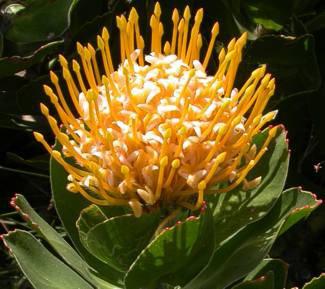
 Abu Shawka [Public domain], from Wikimedia Commons (https://upload.wikimedia.org/wikipedia/commons/5/54/Leucospermum_conocarpodendron_-_Table_Mountain_6.JPG)
Tree Pincushion
Leucospermum conocarpodendron
Social features
Soils
Was once abundant in the area now covered by Cape Town. Check locally appropriate sub-species carefully.
Occurs in clay and sandy soils.
Sugarbirds and sunbirds are main pollinators, and and dispersed (myrmecochory). Seeds survive for 80 to 200 years in the soil!
"Seeds of many fynbos species are known to be long lived and are expected to survive for about 80 years in the soil. The Millennium Seed Bank, Kew, have just pushed that figure back quite considerably by germinating some 200 year-old seeds that were collected at the Cape in 1803 by a Dutch merchant, Jan Teerlink. The ship he was on was captured by British privateers, and all documents, including his notebook containing the seeds, were seized. The notebook was kept in the Tower of London and then the National Archives until it was stumbled upon by curators carrying out cataloguing improvements."
"During flowering season hikers who are lost and without a compass can use the flower heads to navigate by. Flowers on the warmer side of the flower head start opening first, because they receive more direct sunlight."
"Leucospermum conocarpodendron was much used for firewood in and around Cape Town from the beginning of the settlement at the Cape in 1652 and during the 1700s and 1800s. The bark was much used for tanning and was in great demand, wagonloads of it were sold at the Cape Town market. A decoction of the bark was also successfully used in treating dysentery. The wood was used to make felloes for wagons, and was widely used to make charcoal for smithy work. Plants were cultivated in some places to produce bark and wood."
Threats: "home owners living inside the natural distribution range have planted the subsp. viridum in their gardens, which is known to hybridize with subsp. conocarpodendron. This species is bird pollinated and the wild plants are easily within range of the cultivated plants. Cross pollination will contaminate the gene pool and the subspecies could be permanently changed and even wiped out. Home owners inside the distribution range are advised not to grow the subsp. viridum and should remove any plants from their gardens."