Crowberry
Searsia crenata
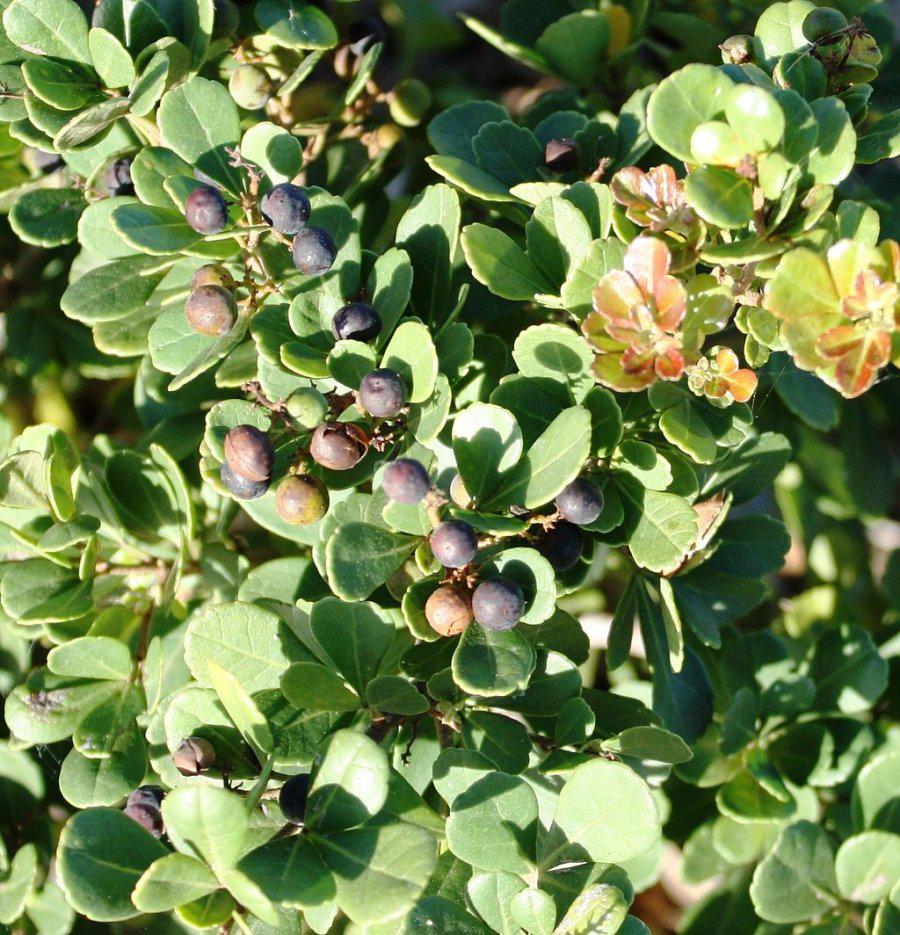 © By Abu Shawka (Own work) [CC0], via Wikimedia Commons (https://upload.wikimedia.org/wikipedia/commons/f/f9/Dune_Crowberry_-_Rhus_crenata_-_South_Africa_3.jpg) (None)
Description - from Wikipedia
Searsia crenata, previously known as Rhus crenata, ("dune crow-berry"), is a species of Searsia that is native to South Africa, where it grows in frost-free and light frost areas, especially on beach sand dunes.
Description
It is a multibranched evergreen shrub or small tree, reaching a height of 3 metres and a similar spread.
The leaf stalks (petioles) are about 2 mm in length. Each leaflet is obovate-cuneate with three distinct bumps at the broad tip (tricrenate).
The small flowers are produced in autumn, and are followed by dark blue fruit eaten by birds.
Distribution
This species is found along the southern coast of South Africa, from Cape Town as far east as the Kei river.
Its favoured habitat is stabilised sand dunes.
Cultivation
The tree is a good subject for bonsai, and can easily be pruned into a very neat hedge. It enjoys full sun and is semi frost hardy.
References
Media related to Searsia crenata at Wikimedia Commons
Read more here
Species Characteristics
Wildlife supported
Tolerances & suitability
Growth features
Social features
Aspect
Plant types
Soils
- Cream
- White