 Paul Hoekman
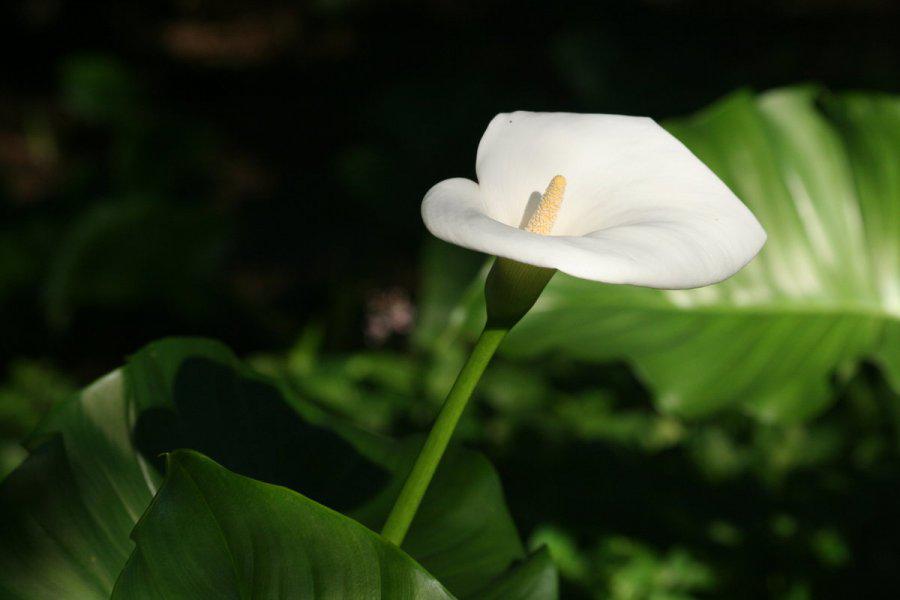
Calla Lily
Zantedeschia aethiopica
Habitats
"Zantedeschia aethiopica grows from 0.6-1 m but may get taller in the shade. It has lush-looking dark green leaves with an arrow head shape. The size varies according to the amount of shade. The flowers appear in a main flush from August to January, although there may be the odd flower at other times of the year also. The white arum forms large colonies in marshy areas ranging from the coast to an altitude of 2 250 m. Thus one will find them contending with humid, salt laden air at the coast and freezing, misty mountain grasslands at high altitudes. They are very versatile in the garden as a result."
Flowers are pollinated by bees and insects and attract frogs, and spiders as well. Fruit is eaten by birds.
The plants can expel excess water allowing them to survive wet conditions. Grow in partial or deep shade with plenty of water, compost and mulch. It is evergreen or deciduous depending on the habitat and rainfall regime. In the Western Cape it is dormant in summer, and in the summer rainfall areas it is dormant in winter. It will remain evergreen in both areas if growing in marshy conditions which remain wet all year round.
The white arum may be used as a marginal plant along streams, or on the edge of a pond. Plant in partial shade if there is no permanent water. It can be planted as a foliage plant in deep shade under trees but will not flower well in this position. It is fast growing and likes very rich, well-drained conditions.
This is a larval host plant to Macroglossum stellatarum (Hummingbird Hawk-moth) caterpillar, attracts bees and other pollinating insects and a white crab spider of the family Thomisidae often visits the flower to capture insects (http://www.plantbook.co.za/zantedeschia-aethiopica/).
Traditionally used for headache treatment.