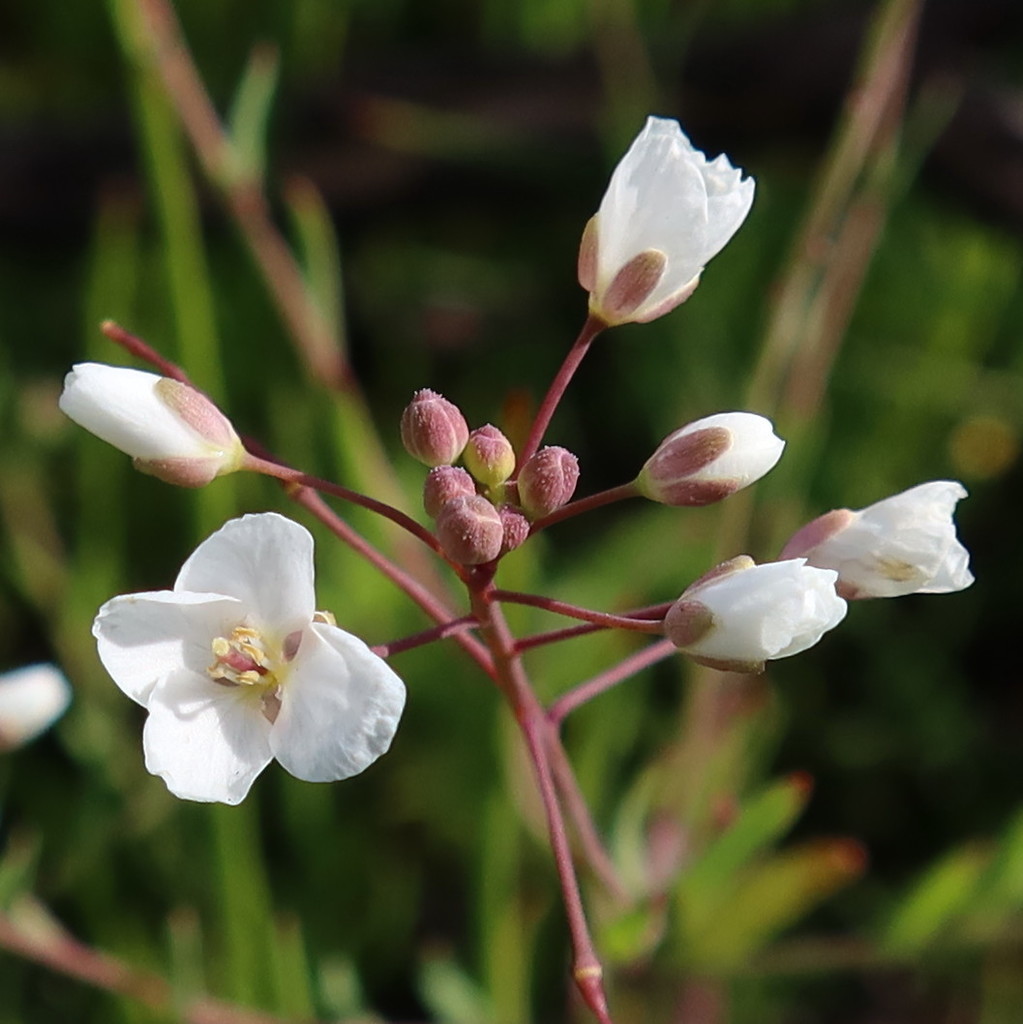
 (c) Diana Studer, some rights reserved (CC BY), uploaded by Diana Studer
Dainty Sunspurge
Heliophila pusilla
Animal-friendly
Heliophila pusilla, the dainty sunspurge, is a species of plant in family Brassicaceae. It is endemic to the Cape Provinces of South Africa.
Heliophila pusilla, the dainty sunspurge, is a species of plant in family Brassicaceae. It is endemic to the Cape Provinces of South Africa.
Description
This slender annual grows up to 30 cm (12 in) tall. The hairless stems are soft and wiry or flaccid. The leaves are thread-like or lance shaped, with the widest portion near the tip. They are 5–35 mm (0.20–1.38 in) long and 3–15 mm (0.12–0.59 in) wide.
Flowers are present between August and October, forming dense racemes. They range from white to mauve in colour. The petals, which range from 2 to 6 mm (0.079 to 0.236 in) in length, sometimes have basal appendages. They have 3-12 ovules.
The fruits have a submoniliform shape and are 5–18 mm (0.20–0.71 in) long. The bead-like structures are either continuous or joined by narrow waists.
Subspecies and varieties
Four subspecies and varieties are accepted:
Heliophila pusilla var. lanceolata (Adamson) Marais
Heliophila pusilla subsp. macrosperma (Marais) Al-Shehbaz
Heliophila pusilla subsp. pusilla
Heliophila pusilla var. setacea (Schltr.) Marais
Distribution and habitat
The dainty sunspurge is found growing between the Kouebokkeveld Mountains and De hoop in South Africa. It has also been introduced in Australia. It prefers clay soils.
Conservation
Although the species as a whole is considered to be of least concern, Heliophila pusilla var. lanceolata is considered to be rare. It is found in damp, sheltered areas on south- and west-facing slopes on Karbonkelberg, Chapman's Peak, and the Noordhoek Mountains.
== References ==