Pied Kalossie
Ixia monadelpha
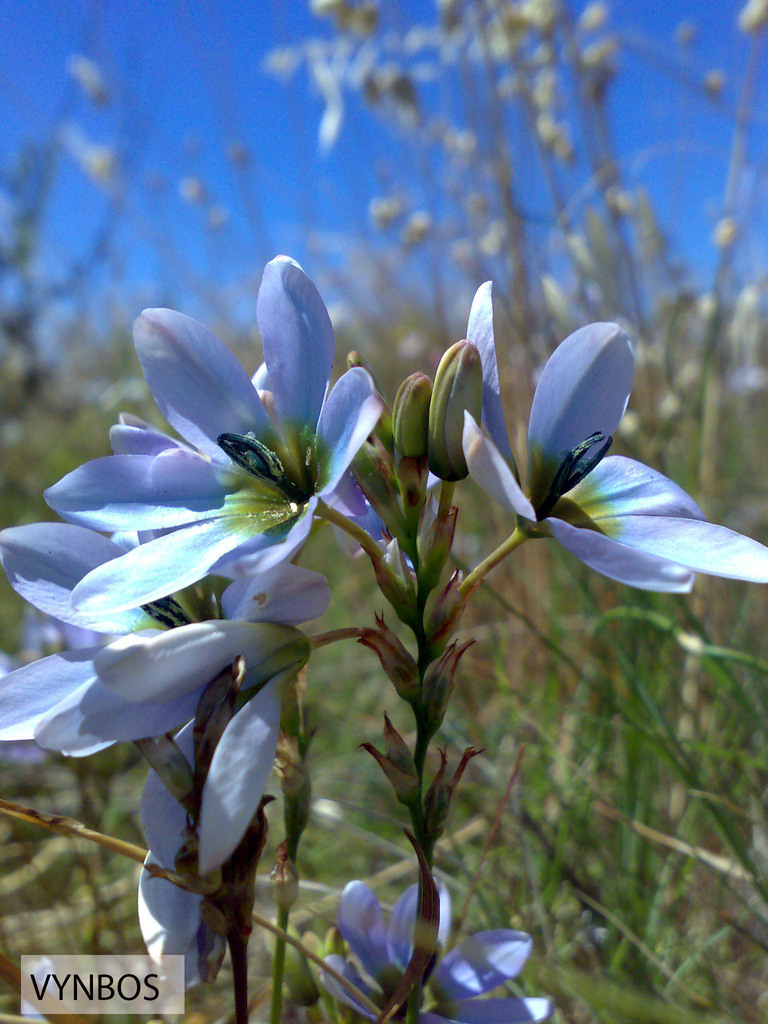 © (c) Chris Vynbos, some rights reserved (CC BY-SA), uploaded by Chris Vynbos (CC-BY-SA)
Description - from Wikipedia
Ixia monadelpha, also known as the pied kalossie or bontkalossie, is an endangered species of geophyte found in wet sandy flats in the southwestern Cape of South Africa.
Description
Growth form
This cormous geophyte grows 15–40 cm (5.9–15.7 in) tall. It has a simple stem with one or two short, spreading branches. They emerge at right angles to the stem and curve upwards.
Corm
The corm is more or less spherical and has a diameter of 12–20 mm (0.47–0.79 in). They are covered in soft, papery layers.
Leaves
The leaves are sword-shaped and are often loosely twisted. There are between four and seven leaves per plant, each of which is about half as long as the stem and 3–12 mm (0.12–0.47 in) wide. The margins are slightly thickened and become transparent when dry.
Flowers
Unscented flowers are present in September and October. Each plant produces between four and twelve salver-shaped flowers that grow close to each other in a flexuose spike inflorescence. Flowers are typically grey-blue to turquoise to purple or pink in colour. Although rare, some plants produce white or grey-yellow flowers. The center is darker, ranging from dark green to brown, red, purple and almost black in colour. The darker center has a light brown or green edge.
The flowers have dark stamens with blue or grey pollen. The filaments are joined for at least half o their length and the purple anthers are erect. The style divides between the base and the middle of the anthers, forming branches that are 2–3 mm (0.079–0.118 in) long.
The pale, dry floral bracts are speckled with brown or red and have distinctive thickened and twisted dark brown cusps. The outer bract with the central cusp in the most prominent.
Taxonomy
Ixia monadelpha is the first species that was put into the eurydice subgenus. Initially proposed as being its own genus, species in this subgenus have fused stamen filaments. This feature is not seen in the rest of the genus. The species epithet monadelpha means one-brothered and refers to the joined filaments.
Distribution and habitat
This species is endemic to a narrow region along the Atlantic Coast in the Western Cape of South Africa. It is currently found growing between Darling in the West Coast region and Hout Bay on the Cape Peninsula, although it was historically found as far as Hopefield and Tulbagh. It is now restricted to between four and six fragmented subpopulations, most of which are around Darling. The largest population in found on Rondebosch Common in Cape Town. Plants are found growing on seasonally wet sandy flats and lower slopes.
Ecology
I. monadelpha is insect pollinated. The dark center of the flower is typical of species that are pollinated by monkey beetles. It is known to be visited by Peritrichia cinerea. and Lepithrix fulvipes, two monkey beetle species.
This species is often found growing alongside Ixia curta, an orange Ixia species that also has fused filaments but differs in other morphological features.
Conservation
This species is considered to be endangered by the South African National Biodiversity Institute. Only a few scattered subpopulations remain in isolated remnants. These populations are declining due to alien vegetation and habitat degradation.
Gallery
References
External links
Media related to Ixia monadelpha at Wikimedia Commons
Data related to Ixia monadelpha at Wikispecies