 (c) Adriaan Grobler, some rights reserved (CC BY-NC), uploaded by Adriaan Grobler
Redstem Asparagus
Asparagus rubicundus
Animal-friendly
Tolerances & suitability
Plant types
Succession
Flowering
- white
Asparagus rubicundus ("red-stemmed asparagus") is a fluffy, thorny shrub of the Asparagus genus, that is endemic to the Cape Provinces of South Africa.
Asparagus rubicundus ("red-stemmed asparagus") is a fluffy, thorny shrub of the Asparagus genus, that is endemic to the Cape Provinces of South Africa.
Description
This species of Asparagus grows as a thorny bush, to a height of 1,5 metres.
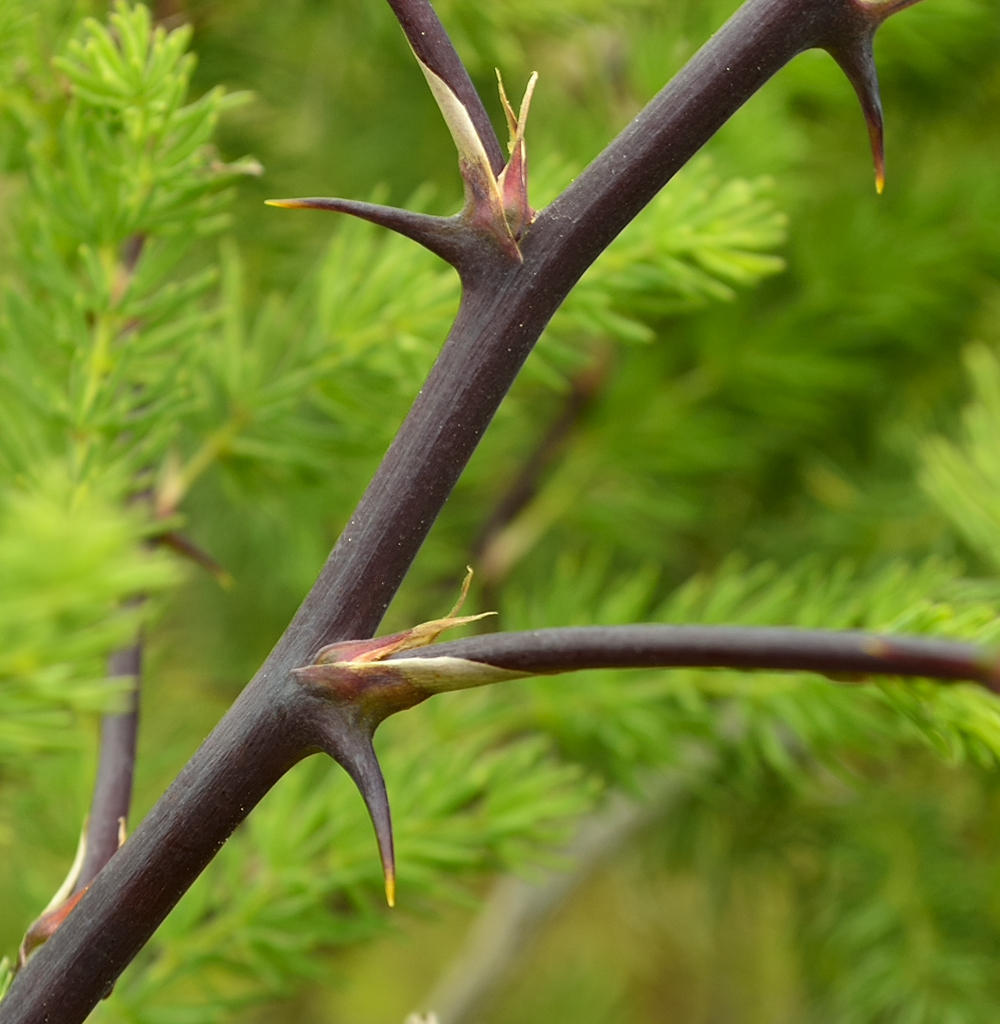
Stems are erect, round, smooth, shiny and have a distinctive dark-brown colour.
At each node along a stem, below the branch, there is a single, recurved-spreading (max.6mm) thorn.
The numerous, thread-like leaves are in feathery tufts of about 10. Individual leaves are small (3-7mm), linear-cylindrical, slightly curved, and slightly broader towards their tips.
The flowers (March–June) are white, usually solitary, and have brown stamens.
The berries are reddish or black, each with a single seed.
The young shoots of this plant are edible, like those of commercial asparagus.
Related species
This species is part of a group of closely related African Asparagus species, including Asparagus lignosus, Asparagus concinnus and Asparagus microraphis.
Distribution
It occurs throughout the southern and western Cape, as far north as Namibia, and as far east as Uitenhage.
It is usually found in coarse sandy, clay or granite-based soil in fynbos or renosterveld vegetation and coastal sand plains.
References
Further reading
Pink, A. (2004). Gardening for the Million. Project Gutenberg Literary Archive Foundation.