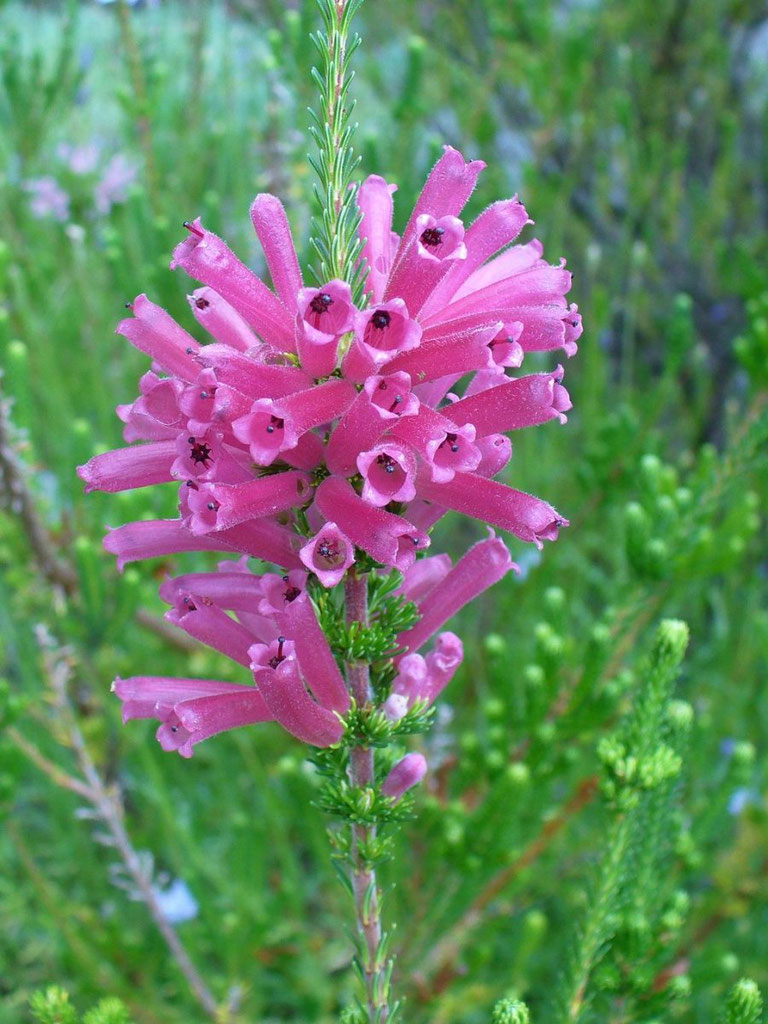
 By Andrew Massyn (Kirstenbosch Gardens Cape Town. Own work) [Public domain], via Wikimedia Commons (https://upload.wikimedia.org/wikipedia/commons/1/1b/Erica_verticillata_deep_pink.JPG)
Whorl Heath
Erica verticillata
Animal-friendly
Tolerances & suitability
Growth features
Habitats
Aspect
Plant types
Flowering
- mauve/lilac
- pink
This plant is extinct in the wild. It has been re-established to three Sand Plain Fynbos reserves within the urban sprawl of Cape Town. These include Rondevlei Nature Reserve, Kenilworth Racecourse Conservation Area and the Tokai Park under management of the South African National Parks. Its status remains Extinct in the Wild and will be re-assessed when it has survived three burn cycles in the wild without restocking or replanting.
Records suggests this species preferred seasonally damp, acid, sandy soils near rivers and wetlands. Like other ericas it depended upon a symbiotic association with micorrhiza fungi to survive the trials of hot dry summers. Erica verticillata is one of the relatively few reliable South African ericas that is comparatively hardy, disease resistant and recommended for planting in both gardens and containers.
Visited and pollinated by hawk moths, bumblebees, bees, beetles and birds such as southern double-collared sunbirds.
Propagation by seed
Erica verticillata does not readily produce seed unless two or more different clones are in relatively close proximity for intraspecific cross-pollination to take place.Seed is sown in late summer or autumn at Kirstenbosch, but best sown at the beginning of the growing season in other areas. It should be sown fresh and be less than three years old unless preserved under optimal seed storage conditions. Seed is sown in seed trays on a well-drained sandy or peat-based potting mixture of equal parts coarse river sand and well-decomposed pine bark or good quality peat. The potting medium should be acidic, contain no manure and have low levels of phosphate with an optimum pH of 5-6.5. The seed is lightly covered with coarse sand, and then subjected to smoke treatment before the trays are watered. This allows for maximum smoke penetration into the medium containing the seed. Smoke is generated in a drum using dry and semi-dry fynbos plant material and is pumped into a sealed plastic tent stretched over a frame containing the trays of seed. The smoke is allowed to settle onto the medium, leaving a brownish film, after which the trays are removed from the tent. The seed trays are lightly watered, taking care not to disturb the seed. The alternative to applying the trays with smoke is to use the Kirstenbosch Smoke Plus Seed Primer which is a disc impregnated with smoke concentrate (Brown et al., 1993). Erica seed germinates approximately three to four weeks after sowing and produces very small cotyledons. The true leaves appear from the eighth to the twelfth week. Seedlings can be pricked out after they have reached 5mm in height into multi-trays or plugs and a well-drained medium to avoid root rot.