Whorl Heath
Erica verticillata
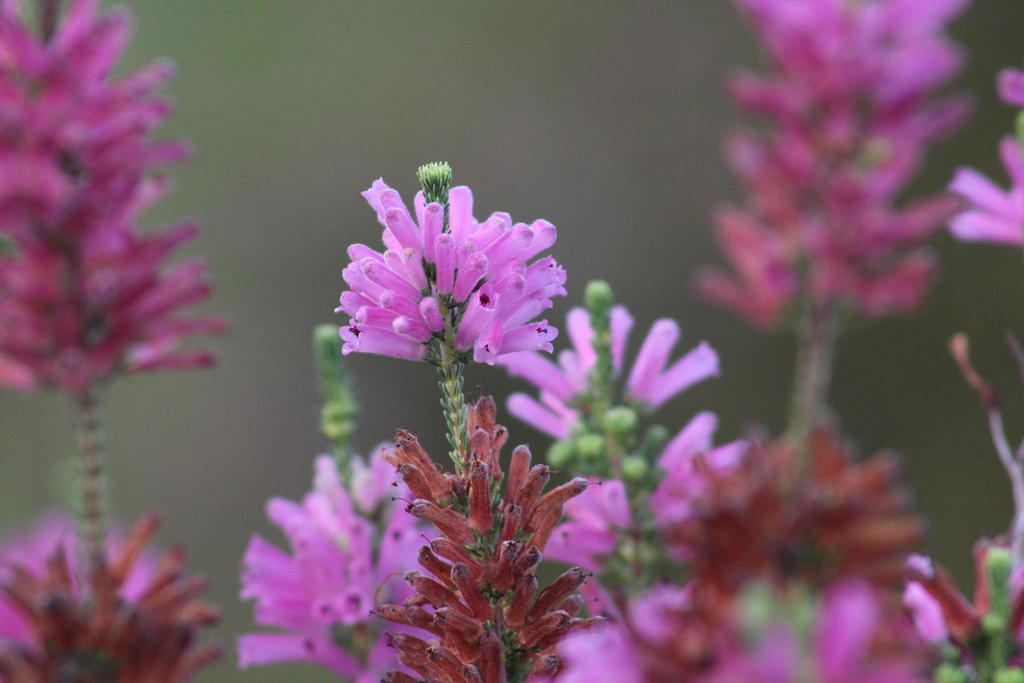 © (c) Callum Evans, some rights reserved (CC BY-NC), uploaded by Callum Evans (CC-BY-NC)
Description - from Wikipedia
Erica verticillata is a species of Erica that was naturally restricted to the city of Cape Town but is now classified as extinct in the wild.
Distribution
It formerly grew only in certain areas of the Cape Flats on the Cape Peninsula of South Africa.
Habitat
It grew in Cape Flats Sand Fynbos, a fynbos type that is threatened by urban sprawl and fragmentation. It preferred damp sandy soils such as those that were naturally found around Wynberg, Kenilworth and Zeekoevlei.
Conservation
Although the species became functionally extinct due to agricultural and urban development of its habitat in the early 20th century, cuttings from several plants discovered in the wild in the later 20th century have ensured that the species will continue in cultivation. 1984 saw the introduction of cuttings from two specimens, one in Protea Park, Pretoria and another in Kew. The former were collected by Kirstenbosch National Botanical Garden scholar David von Well after he recognized the plant from herbarium sheets photocopied by Kirstenbosch horticulturist Deon Kotze. The third infusion came from a plant found by Kirstenbosch foreman Adonis Adonis in a clearing.
This species was introduced back into the wild at Rondevlei, a bird sanctuary and nature reserve in Cape Town.
Ecology
Various pollinators such as bees and birds such as southern double-collared sunbirds have been observed feeding on the tubular pink flowers on E. verticillata.
Cultivation
E. verticillata comes in three forms: the Kirstenbosch form, the Pretoria form and the Kew form. It prefers seasonally moist sandy soils, but will grow well in average garden conditions provided the soils are acidic. The best time to plant is in autumn or during the winter although they may be planted at other times of the year if regularly watered. It is important to never disturb its roots when weeding. Plants should be well watered after planting and then every two to three days unless good rainfalls occur.
Gallery
References
External links
erica/erica-verticillata Erica verticillata media from ARKive
Read more here
Species Characteristics
Wildlife supported
Tolerances & suitability
Growth features
Habitats
Aspect
Plant types
Soils
- Mauve/Lilac
- Pink
Propagation
By Seed
Seed is sown in late summer or autumn at Kirstenbosch, but best sown at the beginning of the growing season in other areas. It should be sown fresh and be less than three years old unless preserved under optimal seed storage conditions. Seed is sown in seed trays on a well-drained sandy or peat-based potting mixture of equal parts coarse river sand and well-decomposed pine bark or good quality peat. The potting medium should be acidic, contain no manure and have low levels of phosphate with an optimum pH of 5-6.5. The seed is lightly covered with coarse sand, and then subjected to smoke treatment before the trays are watered. This allows for maximum smoke penetration into the medium containing the seed. Smoke is generated in a drum using dry and semi-dry fynbos plant material and is pumped into a sealed plastic tent stretched over a frame containing the trays of seed. The smoke is allowed to settle onto the medium, leaving a brownish film, after which the trays are removed from the tent. The seed trays are lightly watered, taking care not to disturb the seed. The alternative to applying the trays with smoke is to use the Kirstenbosch Smoke Plus Seed Primer which is a disc impregnated with smoke concentrate (Brown et al., 1993). Erica seed germinates approximately three to four weeks after sowing and produces very small cotyledons. The true leaves appear from the eighth to the twelfth week. Seedlings can be pricked out after they have reached 5mm in height into multi-trays or plugs and a well-drained medium to avoid root rot.