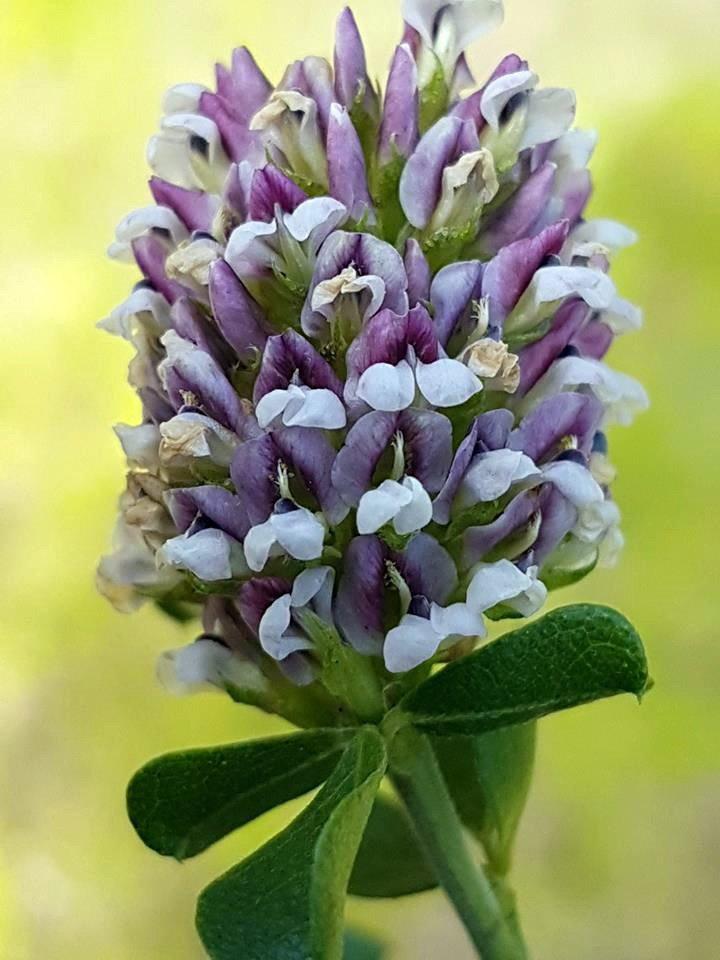
 Paul venter [CC BY-SA 4.0 (https://creativecommons.org/licenses/by-sa/4.0) or GFDL (http://www.gnu.org/copyleft/fdl.html)], from Wikimedia Commons (https://upload.wikimedia.org/wikipedia/commons/4/4b/Otholobium_bracteolatum00.jpg)
Strand Dottypea
Otholobium bracteolatum
Social features
Fragrant
Fragrant
Aspect
Sun
Sun
Plant types
Shrub
Shrub
Succession
Pioneer species
Pioneer species
Flowering
- mauve/lilac
- white
Feb
Mar
Apr
May
Sep
Oct
Nov
Dec
The Cape Town pea is a ground-hugging shrub from the pea family, that forms a mat across the ground and flowering in spring. It survives fires by resprouting from its roots and prefers acid soil.
Not to be confused with its more common relative O. bracteolatum (Skaapbostee), the Cape Town pea occurs only within the Cape Peninsula, now largely restricted to Table Mountain.
"Grow Otholobium fruticans in full sun to semi shade, in well-drained, acidic soils. Feed with well-rotted compost applied as a mulch and if using chemical fertilizers, it is preferable to use a slow-release fertilizer or apply very low doses."