Bugle-lily
Watsonia borbonica
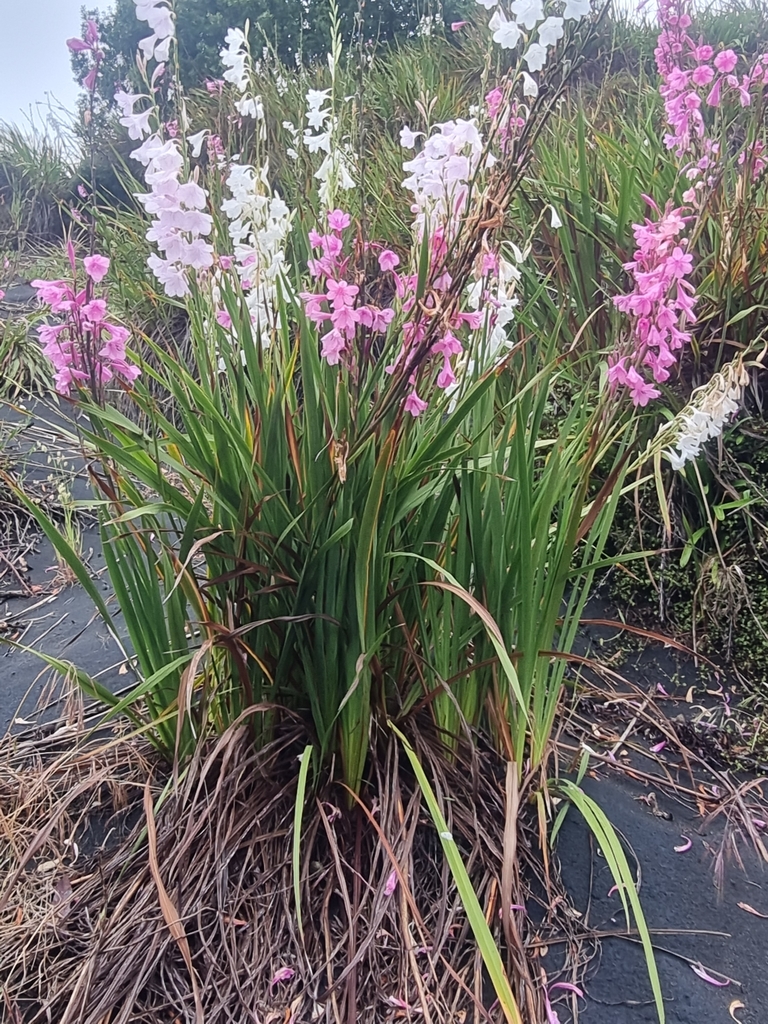 © (c) Tama te ngarutoa, some rights reserved (CC BY-NC), uploaded by Tama te ngarutoa (CC-BY-NC)
Description - from Wikipedia
Watsonia borbonica, the Cape bugle-lily, is a species of plant in the family Iridaceae that is native to South Africa.
Taxonomy
Watsonia borbonica has two subspecies: W. borbonica subsp. ardernei, and subsp. borbonica. W. borbonica subsp. ardernei is named in honour of H.M. Arderne, the Cape Town businessman whose family established the Arderne Gardens in Claremont . This subspecies is best known for its white form that is well-established in cultivation.
Characteristics
The species grows from corms. It is dormant in summer and grows in winter, which is the rainy season in its native habitat. It has tall strap-like leaves growing in a fan arrangement. It may grow up to two metres tall. It flowers for up to 4–5 weeks in spring.
Distribution and habitat
Watsonia borbonica grows in the winter-rainfall areas of the Western Cape of South Africa. It usually grows on slopes consisting of rocky sandstone or clay and granite. It may be found occasionally in sandy soils.
Cultivation
Watsonia borbonica is a good garden plant as it bears showy flowers. It needs well-drained soil and full sun. During the dormant phase it should be kept dry.
== References ==
Read more here
Species Characteristics
Tolerances & suitability
Growth features
Social features
Aspect
Plant types
Soils
- Pink
- White
Propagation
By Seed
It is also advisable to protect them from rain during this period. Seed germinates readily within 3 to 4 weeks. Watering should be reduced towards the end of the growing season and withheld completely when they are dormant, resuming only in the autumn. The plants should flower in their second or third year.
By Cutting
Use a well-drained soil, e.g. a mixture of coarse sand and finely milled bark. Corms should be planted at a depth of approximately half their diameter, 40-60 mm deep. In the winter rainfall area the rains begin in autumn (usually around the beginning of April). Pot grown plants should be watered sparingly at this time, and after they have sprouted, the soil should be kept moist but not damp-the corms are not that sensitive to drying out but if kept too wet they may rot. Corms will flower within a few months of planting.