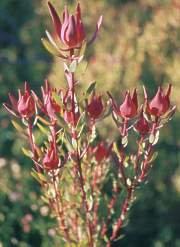
 Dwergenpaartje [CC BY-SA 4.0 (https://creativecommons.org/licenses/by-sa/4.0)], from Wikimedia Commons (https://upload.wikimedia.org/wikipedia/commons/d/d6/Leucadendron_salignum_Avontuur_landscape.jpg)
Common Sunshine Conebush
Leucadendron salignum
Animal-friendly
Growth features
Social features
Aspect
Plant types
Flowering
- cream
- orange
- pink
- red
- yellow
Leucadendrons are dioecious, i.e. separate male and female plants. This is unusual in the protea family. Its long flowering season (May - Dec), coupled with colourful leaves and bracts surrounding the flowers, make this species an attractive garden plant.
Leucadendron salignum is a multi-stemmed shrub with a persistent rootstock, which enables it to resprout after fire. In its natural conditions it grows to a height of 0.75 to 2 m. The variability of growing conditions, from mild winter temperatures to snow and frost near mountain tops, as well as the variability of leaves and bracts, from greenish-yellow to vivid orange-red, have made this species an excellent candidate for breeding.
There are a range of plants in cultivation, which differ markedly from the usual parent species, most often in growth form, leaf- and bract colour and flowering time. They may be either selections, known as 'cultivars' or hybrids, i.e. 'crosses' between species. Many hybrids and cultivars have been produced in South Africa, New Zealand, Australia and other countries growing Proteaceae.