Botterboom
Tylecodon paniculatus
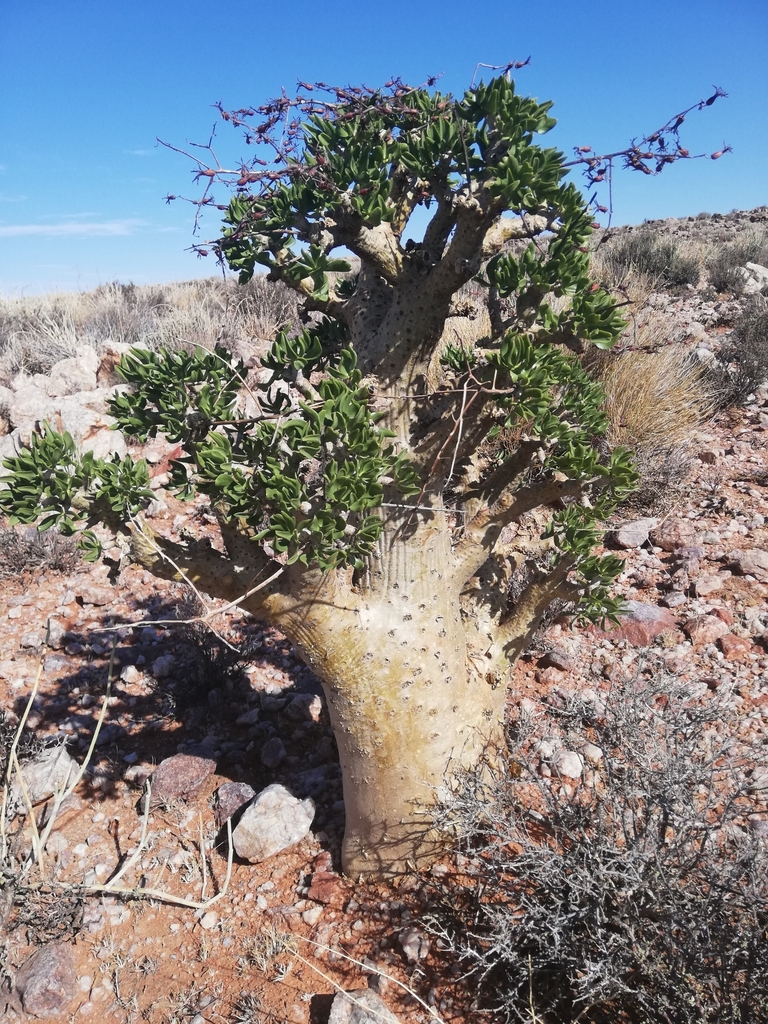 © (c) Helena van Zyl, some rights reserved (CC BY-NC), uploaded by Helena van Zyl (CC-BY-NC)
Description - from Wikipedia
Tylecodon paniculatus, also known as butter bush, butter tree, butterboom or rooisuikerblom (Afrikaans), is a species of succulent plant in the genus Tylecodon belonging to the family Crassulaceae.
Etymology
The genus name is a syllabic anagram of the former name Cotyledon, created by Helmut Toelken who split a few species off into a genus of their own.
The species Latin epithet refers to the shape of inflorescence — branched terminal panicles.
The common names refer to soft, fleshy and brittle stems. For centuries children have used the soft, slippery stems as sleds.
Description
Tylecodon paniculatus is a thickset, robust succulent dwarf tree up to 2.5–3 m tall, with very fat stems with usually well branched rounded crown. The single main trunk and branches are covered with mustard-yellow to olive-green bark peeling in papery semi-translucent sheets. Branches are short, with prominent leaf scars. Leaves are clustered and spirally arranged around the apex of the growing tips simple during the wintertime; they are paddle-shaped, 5–12 cm long and 2–10 cm wide, thickly succulent, bright yellowish-green; apex is broadly tapering to rounded, base is tapering without petiole. The plant is deciduous. Inflorescences are spectacular slender, ascending thyrses to 40 cm, with bright crimson-red stalks. Flowers have five joined sepals and five joined petals, forming an orange-yellow to red urn-shaped tube 1.5–2.5 cm long with spreading lobes. Ten stamens are pendulous at first, then upright as the petal-tube dries.
Hybridises with Tylecodon wallichii.
Habitat
Rocky slopes in Succulent Karoo.
Distribution
The species grows in the arid, winter rain-fall regions from Namibia to the southwestern South Africa.
Toxicity
The plant contains bufadienolide-type cardiac glycoside cotyledoside which causes cotyledonosis or nenta poisoning ("krimpsiekte") in sheep and goats.
Subspecies
Tylecodon paniculatus subsp. paniculatus — southwestern Namibia through to Cape Province.
Tylecodon paniculatus subsp. glaucus van Jaarsv. — Namibia.
Gallery
References
External links
Media related to Tylecodon paniculatus at Wikimedia Commons
Bihrmann
World of Succulents
Read more here
Species Characteristics
Tolerances & suitability
Growth features
Social features
Aspect
Soils
- Red
Propagation
By Seed
Sow the seed in a seed box. DO NOT cover the seeds. Simply sow the seeds in a coarse sand topping, with a well-drained substrate underneath. Water with a fine mister or a fogger once a week during winter and once a month in summer. The seeds will germinate readily during the cooler period of the year. After about two years, the young plants will be about 2-3 cm in height and can be pricked out and planted in bags. Always ensure that plants are grown in a well-drained medium.