Cape Silver Tree
Leucadendron argenteum
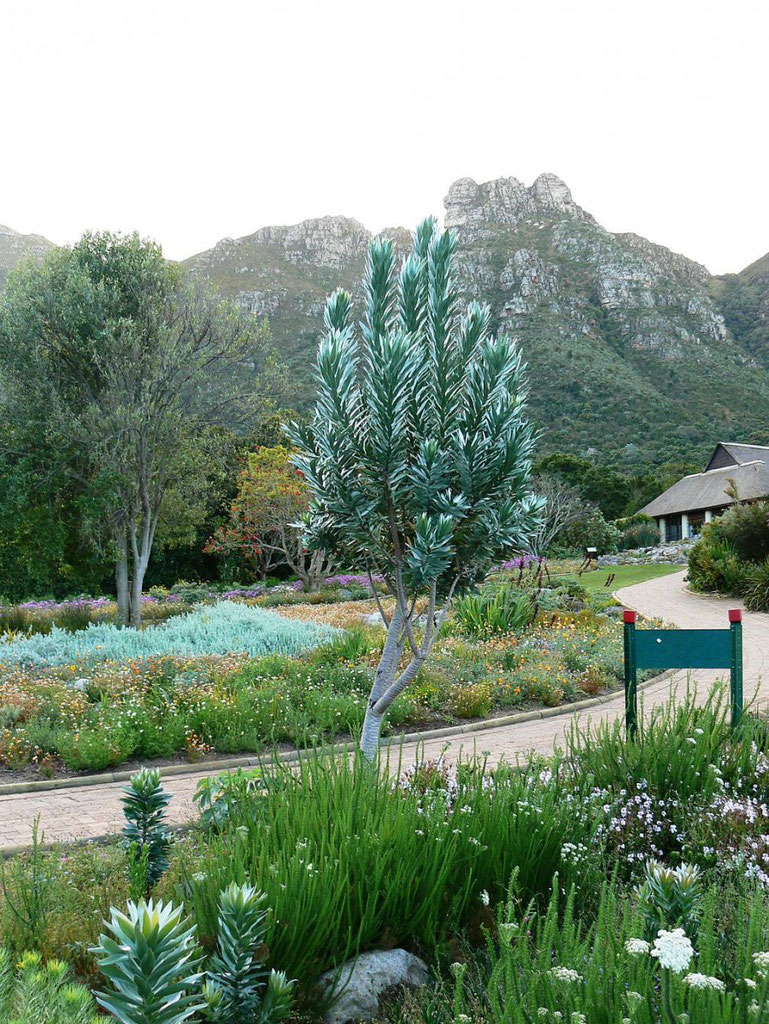 © By Abu Shawka (Own work Transferred from en.wikipedia) [Public domain], via Wikimedia Commons (https://upload.wikimedia.org/wikipedia/commons/b/b6/Leucadendron_argenteum_-_Silvertree_Forest_-_Cape_Town_1.JPG) (None)
Description - from Wikipedia
Leucadendron argenteum (silver tree, silver leaf tree, Afrikaans: Witteboom, or Afrikaans: Silwerboom) is an endangered plant species in the family Proteaceae, which is endemic to a small area of the Cape Peninsula, South Africa. Most grow in and around the city of Cape Town, but outlying (perhaps introduced) populations exist near Somerset West (Silwerboomkloof), Paarl and Stellenbosch. It is a protected tree in South Africa.
Appearance
The silvertree is a striking evergreen tree, growing 5–7 m tall (sometimes up to 16 m). It is erect and well-proportioned with a thick, straight trunk and grey bark. The soft, silky leaves are shiny silver, lanceolate, 8–15 cm long and 2 cm broad, with their distinct silvery sheen produced by dense velvety hairs. The wind-pollinated flowers are produced in dense globose inflorescences 4–5 cm diameter, and give off a pleasant scent. Like all Leucadendrons, this tree is dioecious, with separate male and female plants. The fruit is a heavy woody cone, containing numerous seeds; each seed is a small nut with a silky-haired helicopter-like parachute, enabling it to disperse by wind. After germination it pushes up two green, bare and leathery cotyledons.
Distribution
This enormous silver Protea is naturally confined to a tiny area in and around the city of Cape Town.
Its main population grows on the slopes of Table Mountain, notably the Lion's Head area, above Rhodes Memorial and the mountain slopes above Kirstenbosch National Botanical Garden.
In addition, there are three tiny outlying populations nearby, in Stellenbosch, Somerset West and Paarl (it has not yet been established for certain whether these are natural outliers, or were planted here in early Cape history). The Somerset West population is located within a natural heritage site called Silvertree Gorge, in the Spanish Farm suburb.
Historically, the silvertree was more widespread on Table Mountain, covering much of its slopes in shimmering silver forests. However, early demand for timber led to much of these forests being felled and now the silvertree is a rare and endangered species.
Status and conservation
Table Mountain is perhaps the only place where these trees grow naturally, as the populations near Stellenbosch and Paarl (though conceivably natural) may have been introduced from Table Mountain.
In the face of urban development, inappropriate fire management, and invasive alien trees such as pines and gums, silvertrees have been driven from about 74% of their natural range. Mortality of these short-lived trees is negligible after a burn, but then increases to about 5% per annum. During a longer term absence of burns however, sudden die-offs may occur, even in a matter of hours. This is believed to be the combined result of (warm) berg winds and diseased roots which are weakened by Phytophthora root rot which inhibits their water absorption.
An estimated 40 to 50 percent of the extant native population burned in the fire of 26 to 27 January 2006. As recruitment of seedlings only occurs naturally after fire, this was a necessary stage in the life-cycle of this Fynbos species, and the population has recovered totally.
A major deterrent to propagation of the silver leaf tree is its short life span, as most don't live more than 20 years. This doesn't affect their conservation however, as fires rejuvenate populations on average every 15–20 years by killing the surviving adults and triggering the release of the canopy seed bank (in the cones), and germination of the soil seed bank. Seeds remain viable for at least 80 years. Juveniles take 5–7 years to flower and set seed, whereafter the populations are ready to burn again.
Heraldry
"[S]tylized twigs of the silver tree" [sic] appear in the arms of the South Peninsula Municipality of South Africa.
Pictures
See also
List of Southern African indigenous trees
Peninsula Granite Fynbos
Silwerboomkloof
Rhodes Memorial
Newlands Forest
References
External links
Leucadendron argenteum PlantZAfrica.com
Leucadendron argenteum at the University of Pretoria website
Leucadendron argenteum in the Protea Atlas
Read more here
Species Characteristics
Tolerances & suitability
Aspect
Plant types
Succession
Soils
- Pink
- Yellow
Propagation
By Seed
By Cutting
Before planting, clear the site of weeds and dig in well-matured compost. Dig individual holes large enough for the root ball of each plant. Plant them about 1 m apart. During the first two years the plants must be watered regularly. By mulching with compost or wood chips to a depth of 50 mm, weed development is kept to a minimum. It is important not to dig around the base of a tree, or inside the drip line to avoid damaging the roots, as the root-rot fungus infects the plant via broken or damaged roots. Other advantages of mulching are that the soil is kept moist, soil temperatures are kept down and the plant receives nutrients as it decomposes.
Plants in pots or bags should be planted out or potted up into bigger bags before the roots grow through to prevent damaging the roots.
When growing silver trees, remember that they are very sensitive to any root disturbance and do not dig around their base or inside their drip line. Unfortunately once it is noticed that a tree is infected, the roots will already have been badly damaged and it is too late to save the tree.